
Fire Damage Restoration and Smoke Cleanup in San Antonio, TX
Water Damage Restoration San Antonio connects homeowners, landlords and businesses after a fire with independent restoration providers. Call to be connected with a local fire damage restoration provider in San Antonio for board-up, soot and smoke cleanup, water removal and rebuilding, any hour.
Free referral line, open 24/7
Cost
Free to call
Availability
Call 24/7
Network
Local pros
Your choice
You decide
Notice: This site is a referral service and does not perform the work. You talk to the provider directly, and they can set up an inspection on the call.
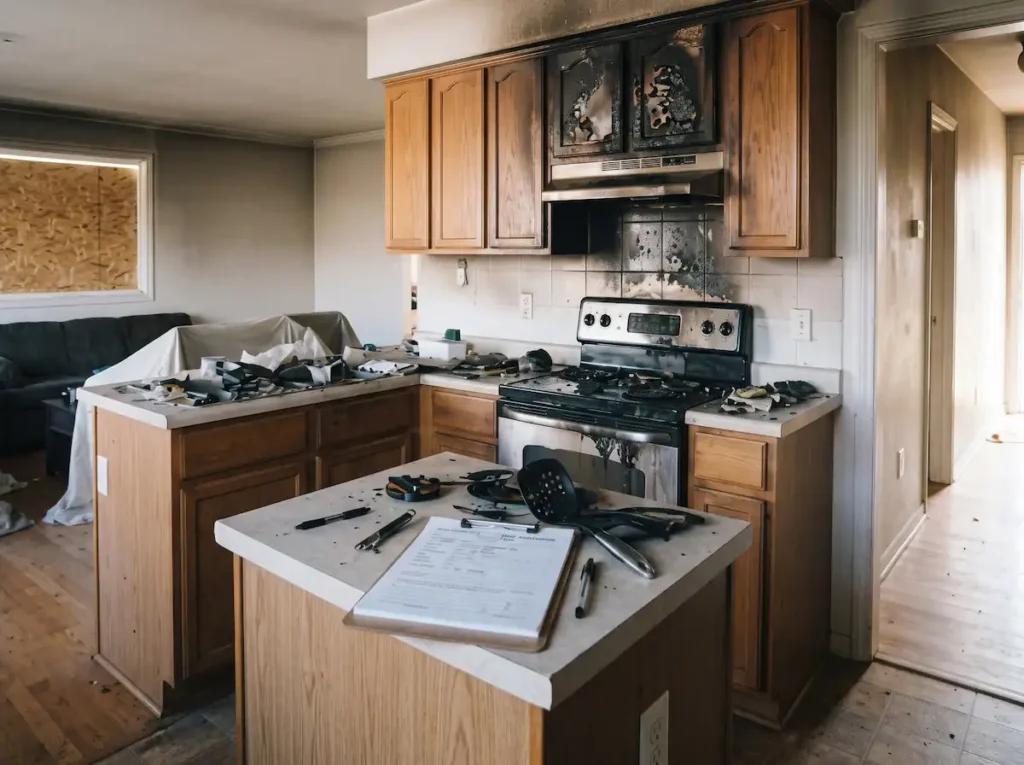
Emergency board-up and soot mitigation
On-site assessment
San Antonio, TX
Kitchen soot, greasy residue and boarded exterior openings. Once firefighters leave, fast mitigation slows soot corrosion and the mold that follows firefighting water.
After the fire trucks leave
San Antonio 24/7 fire damage referral line • Board-up and water extraction
What a fire leaves behind
A house fire leaves three kinds of damage
Fire damage restoration deals with three problems at once: burned structure, soot that drifts into unburned rooms, and the large volume of water used to put the fire out.
1. Structural charring
Heat weakens roof trusses, floor joists, subfloors and framing studs. Direct fire chars wood and destabilizes drywall assemblies.
Action: shoring and demolition
2. Smoke and soot
Fine, acidic soot travels through HVAC returns into unburned rooms, settling in crawlspaces, attics, wall cavities, cabinets and soft contents, where it starts to corrode surfaces.
Action: HEPA filtration and dry chemical sponges
3. Firefighting water
SAFD hoses put large volumes of water into attics and upper floors. It pools under tile and baseboards, and wet drywall can start growing mold within 24 to 48 hours.
Action: extraction and dehumidification
Clear restoration goal
What proper fire restoration achieves
Moving step by step from emergency protection to reconstruction your insurer can sign off on.
Secured envelope
Exterior board-up and heavy roof tarps keep out weather and trespassers.
Soot removal
Acidic residue is cleaned and neutralized on glass, metal, plumbing fixtures and masonry.
Odor removal
The odor source is removed and the framing treated, not masked with fragrance.
Permitted reconstruction
Rebuilding on dry, sound framing with City of San Antonio DSD permits.
Immediate post-fire steps
What to do after a house fire in San Antonio
First-step guidance
Stay out until the fire department says it’s safe, call your insurer, secure the house with temporary board-up or tarps, photograph everything before you move it, and don’t eat food or use medicine that was near heat, smoke or firefighting water. Request the SAFD fire report for your claim.
01 / Safety
Wait for the all-clear
Do not go back in until SAFD clears the structure. For emergency housing, clothing or food, contact the Red Cross at 1-800-RED-CROSS.
02 / Utilities
Leave utilities alone
CPS Energy disconnects gas and electric meters during structure fires. Never reset breakers or gas valves yourself; wait for a licensed professional to clear them.
03 / Security
Secure the house
Your policy expects you to prevent further damage. Board up broken windows, tarp roof openings and keep every receipt.
04 / Inventory
Document first
Photograph and video all damaged belongings before throwing anything out. Food, pantry goods or medicine exposed to heat or smoke should go: “If in doubt, throw it out.”
05 / Claim proof
Get the SAFD fire report
Request the incident report through the City of San Antonio open records portal, by mail, or in person at 315 S. Santa Rosa. Reports are typically ready within 5 to 7 business days.
Need emergency board-up or soot containment right away?
Independent mitigation providers serve all of Bexar County.
Standard protocol
How fire damage restoration works
Most providers follow the ANSI/IICRC S700 standard for fire and smoke damage restoration, which covers structural safety and indoor air quality.
Phase 01
Secure the property
The crew closes up openings within hours: half-inch plywood over windows, secured doors, heavy roof tarps and perimeter fencing.
Phase 02
Assess and document
Each room is checked for the type of residue (synthetic, protein or natural). Moisture meters probe studs, plates and subfloors to build the scope for your insurer.
Phase 03
Extract water and strip debris
Truck-mounted extraction removes firefighting water. Burned drywall and insulation come out to expose the framing for controlled drying.
Phase 04
Clean soot and neutralize odor
Dry chemical sponges lift soot without smearing. Degreasers treat kitchen protein film. Ducts are sealed and cleaned, and thermal fogging treats embedded odor.
Phase 05
Rebuild and permit
The San Antonio Development Services Department (DSD) requires a fire damage assessment before repair permits are issued. Licensed trades replace studs, drywall and finishes.
Firefighting water creates a serious mold risk
Where hundreds of gallons soaked into walls, floors or under cabinets, drying matters as much as soot removal. If it stayed damp longer than 48 hours, mold may already be growing.
Smoke odor
Why smoke smell lingers, and what removes it
Smoke is not just a gas. It is made of tiny solid particles and acidic oils. Heat opens the pores in wood and drywall so smoke gets deep inside, and when the house cools those pores close and trap the odor.
EPA advisory on ozone generators
The truth about ozone treatments
Many owners assume an ozone generator is a quick fix for smoke odor. The U.S. Environmental Protection Agency (EPA) warns against relying on it:
- Harmful to breathe: ozone irritates the lungs and can trigger asthma, even at moderate levels.
- Weak at safe levels: concentrations that are safe to breathe do little to remove odor.
- Damages materials: high ozone levels degrade rubber, carpet padding and some plastics.
Rule: if a provider uses ozone or hydroxyl generators, the building must be empty of people, pets and plants during treatment and fully aired out before anyone goes back in.
Odor removal that works
What actually removes smoke odor
Odor cannot be covered up with sprays or light wiping. Trained providers use a three-step physical process:
1. Source removal
Removing charred drywall, melted ceiling tiles and burned insulation. Material that has turned to charcoal cannot be deodorized.
2. Thermal fogging and hydroxyls
Fine fog particles and hydroxyl treatment reach into the same pores the hot smoke did.
3. Sealing
Shellac-based odor-blocking primer goes on salvaged framing before new drywall closes the walls.
Fire incident benchmarks
When San Antonio house fires happen
National Fire Protection Association (NFPA) data shows when home fires spike nationally. San Antonio homes face the same seasonal risks.
NFPA cooking benchmark
About 4x
Home cooking fires on Thanksgiving Day compared with a typical day. Grease fires spread fast through range hoods and cabinets.
Seasonal heating hazards
Half
About half of home heating fires happen in December, January and February, which lines up with Texas cold snaps and first freezes.
Equipment breakdown
About 80%
Share of fatal home heating fires that involve space heaters, often placed too close to curtains, bedding or furniture.
San Antonio local factors: freezes and fireworks rules
San Antonio’s average first freeze falls around November 30, and cold snaps bring more space heater fires in older homes without central heat. Bexar County allows fireworks in some unincorporated areas, but the City of San Antonio bans them inside city limits.
Texas insurance rules
Fire insurance claims in Texas: what protects yours
Knowing the Texas rules helps you avoid claim delays, denials and predatory contractor tactics after a house fire.
TDI guideline
Fire and smoke are covered
Standard Texas homeowners policies cover sudden and accidental fire and smoke damage, including smoke from a fire on a neighboring property.
Tex. Ins. Code §542.055
15-day claim clock
Once notified of a claim, most Texas insurers have 15 days to acknowledge it, start investigating and request what they need from you.
ALE coverage
Living expense limits
Additional Living Expenses (ALE) pays for a hotel and meals if your home is unlivable. TDI notes typical limits of 10 to 20 percent of your dwelling coverage.
Mitigation rule
Temporary repairs only
Before the adjuster inspects, do only emergency board-up and drying. Permanent repairs started before the inspection can lead to a denied claim.
Tex. Ins. Code §4102.163
Conflict of interest ban
In Texas, a restoration contractor cannot also act as your public insurance adjuster on the same job, and cannot negotiate your coverage for you.
Tex. Bus. & Com. §27.02
Deductible waivers are illegal
Texas law bars contractors from offering to pay, waive or rebate your insurance deductible. Doing so is a Class B misdemeanor.
Texas Department of Insurance consumer help line
Questions about fair claim practices? Call TDI at 800-252-3439.
Consumer protection
Questions to ask a fire restoration provider
Before you let any crew start work, check their credentials against industry restoration standards.
Question 01
Are your technicians IICRC fire and smoke certified?
Look for technicians with a current IICRC Fire and Smoke Restoration Technician (FSRT) credential who follow the ANSI/IICRC S700 standard.
Question 02
How will you match cleaning methods to my residue?
Untrained crews smear dry soot by wetting it, or use dry sponges on greasy kitchen residue. A good provider explains the method for each type of residue.
Question 03
Will I receive an itemized contents inventory?
Ask for a photo inventory of every packed-out item, separating what can be cleaned from total losses, before anything leaves the house.
Question 04
Who requests the city’s fire damage assessment?
In San Antonio, rebuilding needs DSD assessment paperwork before permits are issued. Ask who handles the inspections with the city.
Question 05 / Red flags
What should make you walk away?
Never hire a contractor who shows up uninvited after hearing fire radio traffic, offers to “waive your deductible,” demands full payment upfront, or asks you to sign a blank work authorization without an itemized scope.
Coverage
Fire damage restoration across San Antonio and Bexar County
Calls are routed by ZIP code to independent providers that cover urban, suburban and rural Bexar County.
Urban core and Midtown
Downtown, Monte Vista, Alamo Heights, Southtown and Olmos Park, where many homes need historic plaster work, older hardwood care and outdated wiring repairs.
North and Hill Country corridor
Stone Oak, Timberwood Park, Helotes, Sonterra and Hollywood Park, with larger multi-story homes that need high-capacity drying and soot removal.
South and outer Bexar County
Southside, Brooks, Elmendorf, Somerset and Converse, including full board-up, heavy equipment and post-fire work on commercial and warehouse buildings.
Frequent questions
Fire damage questions
Plain answers about the referral line, Texas claims and restoration.
Is this website a fire restoration company?
No. Water Damage Restoration San Antonio is a free referral service. We do not do restoration, board-up or cleaning. We connect you with independent local restoration providers serving San Antonio and Bexar County. You speak directly with the provider, and you decide who to hire.
Can fire-damaged homes be repaired?
Yes. Unless the City of San Antonio Development Services Department or a licensed structural engineer finds the foundation and framing beyond saving, homes are routinely rebuilt. That means removing charred materials, reinforcing framing, deodorizing the structure and pulling permits to rebuild.
Who cleans up after a house burns down?
The property owner hires the restoration company. The city, SAFD and insurers do not clean up fire damage themselves. Your insurer pays covered costs up to your policy limits, but you choose and authorize the provider that does the board-up, water extraction and cleaning.
Does homeowners insurance cover fire and smoke damage in Texas?
Yes. Standard Texas homeowners policies cover direct fire and smoke damage, along with water damage from firefighting. Under Texas Insurance Code §542.055, insurers must acknowledge your claim within 15 days of notice. Most policies also include Additional Living Expenses (ALE) for a hotel, rent and meals during repairs.
Can smoke smell be completely removed?
Yes, but only with real physical work. Air fresheners and safe levels of ozone will not do it. Removing smoke odor means stripping charred drywall, cleaning the HVAC ducts, treating framing with thermal fogging or hydroxyls, and sealing wood with a shellac-based odor-blocking primer.
Will I get a price before work starts?
You should. Providers inspect the site and write an itemized estimate, often in insurance estimating software such as Xactimate, before major restoration work. Emergency stabilization, like a midnight board-up, is usually billed at emergency time and materials rates.
Free 24/7 referral line
Dealing with fire or smoke damage right now?
Call to be connected with a local fire damage restoration provider in San Antonio. Free to call, 24/7. Independent providers handle emergency board-up, water extraction and soot cleanup.
Direct connection to a local provider