
Flood Damage Restoration in San Antonio, TX
Water Damage Restoration San Antonio connects homeowners and businesses with floodwater inside to independent flood cleanup providers. Call to be connected with a local flood damage restoration provider in San Antonio for pump-out, tear-out, disinfection and drying, any hour.
Free referral • Routed by ZIP code • 24/7
Free to call
Call 24/7
Independent pros
You decide who to hire
Referral note: this site is a referral service and does not perform the restoration work.
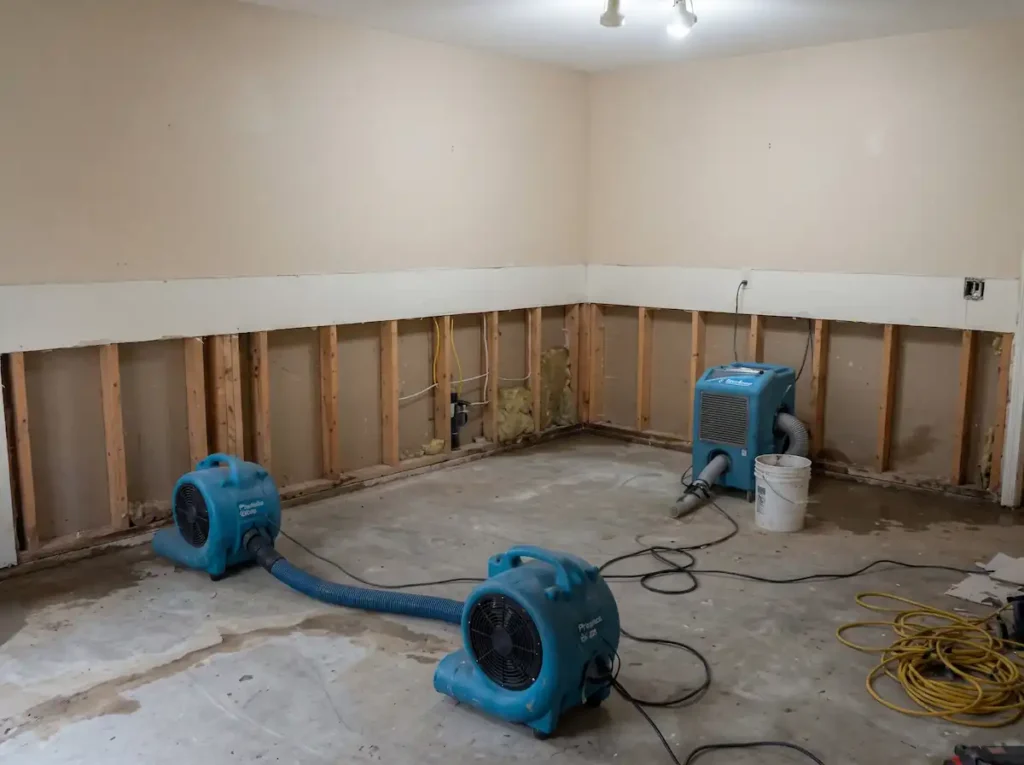
Standard field protocol
Flood cuts, high-velocity air movers and low-grain refrigerant (LGR) dehumidifiers on exposed wall studs.
How calls are routed
Each caller is connected with an independent provider whose service area covers their ZIP code, from the Hill Country corridors along Loop 1604 to the inner Loop 410 neighborhoods and the southern Bexar river basins.
Sanitary categories and pathogen control
Why flood damage is a bigger job than an indoor leak
Water that washes across yards, roads or creek beds before entering your building is different from a burst supply pipe, both in how insurance treats it and in what it carries. It needs biosafety measures.
IICRC Category 3 contamination
Grossly contaminated water
Unlike clean water from an interior pipe (Category 1), overland storm water and rising surface water can carry sewage, petroleum residue, chemical runoff from roads, animal waste and bacteria. Drying it in place leaves those contaminants inside porous materials.
Standard industry rule:
Porous items soaked with Category 3 water cannot just be dried with household fans. They have to be cut out and the remaining structure cleaned and sanitized.
What proper restoration achieves
Restoration scope
- Contaminated tear-out: fast removal of contaminated drywall, insulation and soft subflooring.
- Disinfection: EPA-registered antimicrobial treatment of concrete slabs and wood framing.
- Measured structural drying: daily moisture mapping until materials reach normal dry readings.
- 24 to 48 hour mold prevention: stopping mold growth before it takes hold in the structure.
Ask for daily moisture logs for your adjuster
First steps
What to do first after a flood in San Antonio
Flood first steps
Wait until the water stops rising and the electricity is safe, photograph every room and the water line on the walls, report the loss to your flood insurer, and get cleanup started within 24 to 48 hours. Keep children and pets out of the water.
Step 01
Check roads first
Never drive or walk back home through moving water. Check road status on BexarFlood.org, which monitors more than 190 automated low-water crossing sensors across San Antonio creeks.
Rule: turn around, don’t drown
Step 02
Treat power as live
Do not enter standing floodwater if outlets, cords or the breaker panel are underwater. Contact CPS Energy or a licensed electrician to pull the meter or isolate circuits. If you smell gas, get out.
Utility: CPS Energy 210-353-HELP
Step 03
Document before removal
Take wide shots and close-ups of the highest water stain on walls, baseboards, door casings and columns. Photograph labels, model numbers and serial numbers of damaged appliances.
Needed for NFIP claim evidence
Step 04
Report to the right insurer
Rising floodwater is covered by a flood insurance policy (NFIP or a private flood carrier), not regular homeowners insurance. The standard NFIP deadline for a signed proof of loss is 60 days.
Notice: FEMA 60-day clock
Need water pumped out now?
Call the free referral line to reach an independent Bexar County flood cleanup provider.
Standard operating procedure
How professional flood damage restoration works
Most independent restoration providers follow the ANSI/IICRC S500 standard to return a flooded property to a dry, structurally sound condition.
1
Moisture mapping
Thermal cameras and moisture meters find trapped water behind baseboards, under sill plates and below tile.
2
Pump and extraction
Submersible pumps remove standing water, then commercial wet vacuums pull out mud, sludge and silt.
3
Flood cuts and demo
Drywall is cut in clean horizontal lines 12 to 24 inches above the highest wet reading. Wet insulation is bagged and removed.
4
Sanitize and dry
EPA-registered antimicrobials go on the exposed structure, then LGR or desiccant dehumidifiers and air scrubbers run.
5
Structural rebuild
Once framing reaches a normal dry reading (often under 16 percent moisture content), insulation, drywall and flooring go back in.
Material evaluation
What can be saved after Category 3 floodwater?
Knowing which materials absorb contamination keeps your family safe and helps settle your insurer’s repair scope.
Usually removed and thrown out
Porous materials that absorb floodwater, bacteria and sewage cannot be reliably sanitized:
- Carpet and carpet pad: traps silt, bacteria and other contaminants.
- Drywall and batt insulation: wicks water upward, and the paper facing can grow mold within 48 hours.
- Upholstered furniture and mattresses: deep padding cannot be disinfected.
- Laminate and particleboard cabinets: swell, delaminate and crumble.
Often saved with treatment
Dense, non-porous and structural materials can be washed, disinfected and dried:
- Wood framing: studs and bottom plates can dry back to normal.
- Concrete slabs and foundation beams: pressure-washed and treated.
- Ceramic tile and natural stone: clean well, though grout may need sealing.
- Solid hardwood furniture and metal: can be cleaned and air-dried.
Flash Flood Alley
Why San Antonio floods faster than most US metros
San Antonio sits on the Balcones Escarpment, the sharp divide between the Texas Hill Country and the coastal plain. When moist Gulf air hits this limestone ridge, heavy rain collects in narrow rocky drainages and pours into city streets in minutes.
National Weather Service historical record
13.35 in.
in 24 hours
Recorded at San Antonio International Airport on October 17 and 18, 1998, during the historic South Texas flood. That month closed at 18.07 inches, the wettest single month in San Antonio history.
Source: National Weather Service Austin/San Antonio office
Recent rainfall surge
2.5 in.
county-wide average
Recorded on October 1, 2026 across Bexar County, triggering swift-water rescues, including at Seguin Road and the Salado Creek basin, as reported by Texas Public Radio.
Source: Texas Public Radio and Bexar County emergency response
San Antonio River Authority (SARA) draft floodplain updates
SARA studies show significant flood damage happens outside FEMA-mapped 100-year zones, because intense local storms overwhelm culverts and storm drains. Check your parcel in the SARA draft floodplain viewer.
Bexar County service basins
Flood cleanup across San Antonio and Bexar County
Flood risk follows the creeks. Providers in the network cover each of these drainage areas, so tell the line your ZIP code when you call.
Salado Creek basin
From North Central down to the East Side, including areas near Losoya, Fort Sam Houston and the Northeast Loop 410 corridor.
ZIPs: 78209, 78217, 78218, 78239, 78247
Leon Creek corridor
Northwest elevations near UTSA, the Helotes border and the Medical Center, down through the Southwest military gateway.
ZIPs: 78229, 78240, 78249, 78250, 78251
Olmos Basin and Midtown
Low-lying areas around the Olmos Reservoir, Alamo Heights, Terrell Hills, Monte Vista and the inner-city drainage channels.
ZIPs: 78212, 78201, 78216, 78205
Medina River valley
Southern Bexar acreage, Von Ormy, the Somerset road corridors and low alluvial soils prone to long-standing water.
ZIPs: 78073, 78264, 78221, 78224
San Antonio River reach
South of downtown past the Mission Reach, King William and Espada, where storm water funnels toward the southern county line.
ZIPs: 78204, 78210, 78214, 78223
Storm drain overflows
Dense neighborhoods inside Loop 410 where curbs overflow and drains back up during downpours of 2 inches or more.
All greater San Antonio ZIP codes
Texas coverage basics
Flood insurance in Texas: what to know before you file
A flood claim follows a different path from a regular homeowners claim. Review these rules first:
1
Standard policies exclude rising water
A standard Texas homeowners policy excludes damage from water rising from outside the home. Overland flooding needs a separate policy through the National Flood Insurance Program (NFIP) or a private flood insurer.
2
NFIP 30-day waiting period
You cannot buy flood coverage as a storm approaches. New NFIP policies usually have a 30-day wait before coverage starts, with limited exceptions such as a home purchase closing.
3
The 60-day proof of loss deadline
Under federal rules, policyholders submit a signed, sworn proof of loss with itemized repair estimates within 60 days of the flood. Supplemental claims can be filed later if hidden moisture turns up.
4
Sewer backup rules
If the sewer backs up into your home, NFIP covers it only when the backup was caused directly by general flooding in your area. Routine backups need a sewer backup endorsement on your homeowners policy.
5
Federal disaster declarations
If Bexar County is declared a federal disaster area, homeowners may qualify for FEMA Individuals and Households Program grants or low-interest SBA loans through DisasterAssistance.gov.
Need policy guidance?
Not sure whether your policy is written by the NFIP or a private insurer? Start with the federal resources:
FloodSmart help line
Policy information
Independent providers can supply itemized drying records for your adjuster.
Contractor vetting checklist
Questions to ask before hiring any flood restoration provider
You choose and hire the provider directly, so ask these questions to make sure your home is handled to certified standards:
Question 01
“Are your technicians IICRC certified in Water Damage Restoration (WRT) and Applied Structural Drying (ASD)?”
Proper drying takes knowledge of psychrometrics, vapor pressure and dehumidifier sizing. Uncertified crews often pull equipment too early, leaving moisture in wall cavities to grow mold.
Question 02
“How do you decide how high to cut the drywall?”
Good providers do not guess. They cut 12 to 24 inches above the highest wet reading on a calibrated moisture meter, which avoids tearing out more wall than needed.
Question 03
“Do you supply daily moisture logs and photo reports for my adjuster?”
Adjusters look for daily humidity readings, moisture measurements and photos of the water line before releasing full payment.
Question 04
“Are you licensed by the Texas Department of Licensing and Regulation (TDLR) for mold?”
In Texas, mold remediation covering 25 contiguous square feet or more requires a TDLR license. Ask for license details if mold is already growing.
Common questions
San Antonio flood damage questions
Direct answers about emergency response, insurance claims and restoration in Bexar County.
Is this website a flood cleanup company?
No. Water Damage Restoration San Antonio is a free 24/7 referral line. When you call (210) 890-4820, your call is routed to an independent flood cleanup provider based on your Bexar County ZIP code. You speak with, vet and hire the provider directly.
How do you fix flood damage in a house?
Fixing flood damage takes five steps: extract standing water and silt, remove wet drywall and insulation (flood cuts), apply EPA-registered antimicrobials, dry the framing and slab with commercial dehumidifiers, and rebuild once the framing reaches a normal dry reading.
Can a flooded house be saved?
Usually, yes, if water extraction and tear-out begin within 24 to 48 hours. Concrete foundations and wood framing dry well once wet insulation and drywall come out. Standing water left for days leads to wood rot and widespread mold.
Does homeowners insurance cover flood damage in Texas?
Standard homeowners policies generally exclude damage from rising ground water, creek overflow or street flooding. That needs a separate flood policy, usually through the NFIP or a private insurer. A burst pipe inside the home is typically covered by a standard policy; overland flooding is not.
What is the difference between water remediation and restoration?
Remediation, or mitigation, is the emergency work that stops further damage: water extraction, removing wet materials, sanitizing and drying. Restoration is the rebuild that follows: new drywall, paint, trim, cabinets and flooring.
Do providers give a price before starting?
Providers inspect the property with thermal cameras and moisture meters and should give you a written scope and estimate before non-emergency structural work. Most work directly with flood adjusters using standard estimating software such as Xactimate.
Free 24/7 referral line
Floodwater in the house right now?
Call to be connected with a local flood damage restoration provider in San Antonio. Free to call, 24/7.