
Mold Removal and Remediation in San Antonio, TX
Found mold in your San Antonio home, rental or business? Call to be connected with a local mold remediation provider in San Antonio. Independent providers in our network find the moisture source, contain the area, remove moldy materials and dry the structure.
Core rule: Mold follows water. Clean it without fixing the leak and it comes back, so the job has to cover both.
Free 24/7 referral line
Free to call. You talk to the provider directly and decide whether to hire them. This site is a referral service and does not perform mold remediation.
Free to call
Call 24/7
Independent local
You decide who to hire
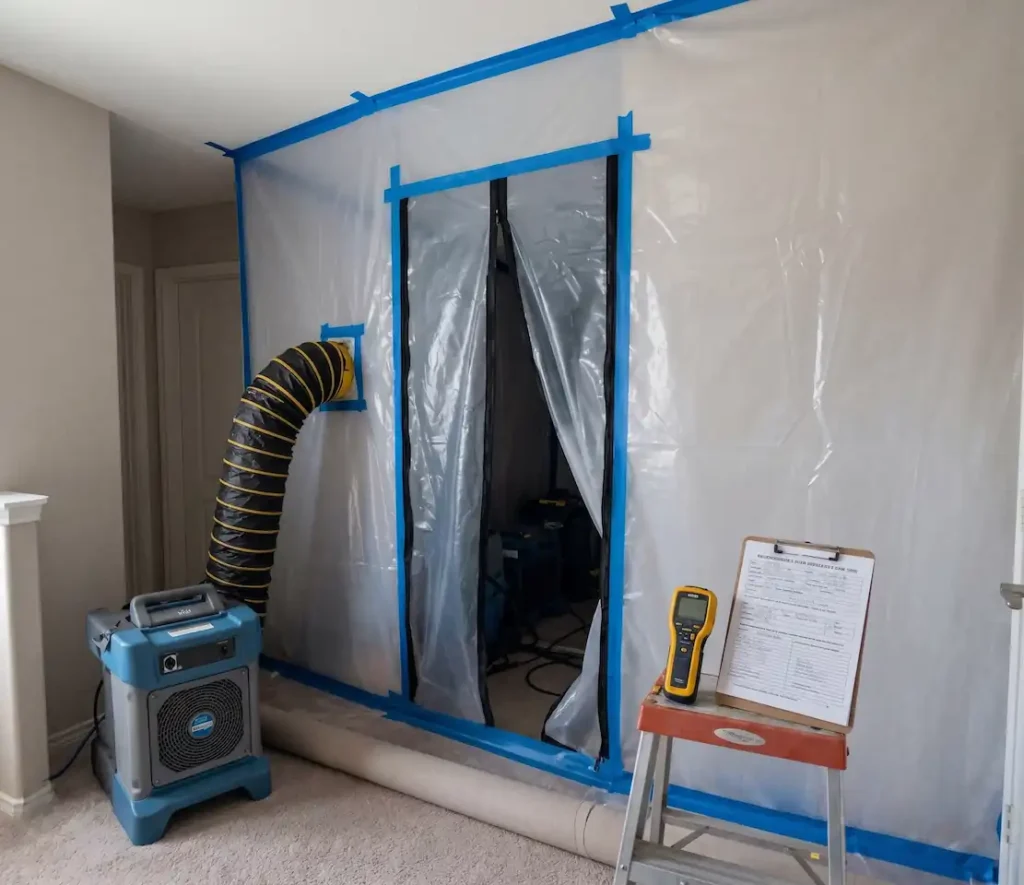
Containment first
Containment priority: negative air HEPA filtration and a sealed poly barrier
Free 24/7 referral line for San Antonio and Bexar County
Early signs
Signs you have a mold problem, not just a stain
A musty smell that won’t clear is usually the first sign, and it often shows up before any mold is visible.
Mold grows faster above 60% relative humidity
Spotting
Black, green or white spotting on drywall, baseboards, ceilings or cabinet backs.
Visual marker 01
Ceiling blisters
Bubbling paint, soft drywall or brown water stains, especially on ceilings below an attic AC unit.
Visual marker 02
HVAC vents
Dark growth around AC vents and return grilles, pointing to condensation in the ductwork.
Visual marker 03
Recurring growth
Mold that grows back in the same spot after you cleaned it, because the material behind it is still wet.
Visual marker 04
Lingering damp
Any area that stayed wet for more than a day or two after a leak, burst line or local flooding.
Visual marker 05
Bexar County moisture sources
Where mold starts in San Antonio homes
Mold in San Antonio homes almost always traces back to a specific moisture source. Finding it is the first job, because the EPA is blunt about this: the key to mold control is moisture control.
HVAC risk
Attic AC units and condensate lines
If your air handler sits in the attic, as it does in many Texas homes, a long cooling season means months of condensate. A clogged drain line overflows into the ceiling below, soaking blown-in insulation and ceiling drywall.
Primary summer source
Duct sweating
Ducts and vents
Cold supply ducts running through a hot, humid attic can sweat. Moisture collects around registers and in duct insulation, and mold follows, sending spores through the airflow.
Attic duct condensation
Soil movement
Slab leaks
Clay soils that swell and shrink stress the water lines under many local slabs. A slow slab leak keeps flooring, tack strip and lower cabinets damp for weeks before anyone sees it.
Hill Country storms
Roof leaks and flash flooding
Storm water that gets into walls or ground-floor rooms brings contamination with it. Anything left wet past 24 to 48 hours is at high risk of mold and bacterial growth.
Relative humidity
Indoor humidity
The EPA recommends keeping indoor humidity below 60 percent, ideally between 30 and 50. Bathrooms without working exhaust fans and closed-up rooms are where it creeps higher, leaving mildew on trim and cabinets.
EPA guideline: 30 to 50% RH
Immediate action
Unsure what is feeding the moisture?
Independent technicians use infrared thermal cameras and moisture meters to trace hidden dampness behind drywall.
TDLR mold rules
How Texas mold rules work, and why they protect you
The Texas threshold is 25 contiguous square feet. In Texas, mold remediation covering 25 contiguous square feet or more must be done by a contractor licensed by the Texas Department of Licensing and Regulation (TDLR), working from a protocol written by a separate licensed mold assessment consultant.
Strict legal rule
No conflict of interest
The same company cannot write the protocol and do the remediation.
Step 01
Assessment and protocol
A licensed mold assessment consultant inspects the property, identifies the moisture problem and writes the remediation protocol.
Step 02
Separate work plan
A licensed remediation contractor writes a work plan that follows the consultant’s protocol. The same company cannot do both jobs.
Step 03
Consumer information sheet
Both licensees must give the owner the TDLR consumer mold information sheet before work starts.
Step 04
Containment and remediation
The contractor sets up sealed containment, runs negative-air HEPA scrubbers, bags and removes moldy drywall and insulation, and deals with the moisture source.
Step 05
Post-remediation clearance
The independent assessment consultant returns, checks the area visually, may take air or surface samples, and confirms clearance before rebuilding.
Step 06
Certificate of Mold Damage Remediation (CMDR)
The licensed remediator issues a CMDR. Under Texas Insurance Code §544.303, it helps protect you from adverse underwriting when you sell or insure the home.
Areas under 25 contiguous square feet: can legally be handled without the licensed protocol process, but proper containment still matters so spores do not spread into your HVAC system.
Spraying biocide or bleach is not remediation
The EPA notes that dead mold can still cause allergic reactions. Painting over mold or fogging chemicals leaves the dead growth in place. Contaminated material has to be contained and physically removed.
IICRC S520 standard
What mold remediation involves in practice
Professional mold remediation follows the IICRC S520 Standard for Professional Mold Remediation:
1
Find and stop moisture
Locate the plumbing leak, roof leak or HVAC condensation problem with thermal cameras and moisture meters, without tearing into walls first.
Diagnosis
2
Contain the area
Put up 6-mil plastic barriers with zippered entry and run negative air machines that exhaust through HEPA filtration (99.97% at 0.3 microns).
Containment
3
Remove porous materials
Carefully cut out moldy drywall (at least 12 inches past visible growth), insulation, contaminated tack strip and carpet pad, and bag it inside the containment.
Sealed disposal
4
Clean what stays
HEPA-vacuum the framing, wire-brush or sand growth from wood subfloors, and apply EPA-registered antimicrobial cleaners.
Framing cleaning
5
Dry and confirm
Run commercial LGR dehumidifiers until wood moisture drops below about 15 percent, then confirm with a final independent clearance inspection.
Dry standard
6
Rebuild and restore
Hang new mold-resistant drywall, tape, float and texture to match, and reinstall baseboards and trim.
Restoration
Testing
Do you need mold testing first?
The CDC and EPA take a straightforward position: if you can see mold or smell it, you do not need routine testing to confirm it is mold. Sampling adds cost when the plan is the same either way: find the leak, contain the room, remove the damaged materials and dry the structure.
When testing does make sense:
- Hidden moisture with no visible growth, when you suspect mold inside wall cavities.
- Post-remediation clearance testing, to show spore levels are at or below outdoor background levels.
- Real estate closings or landlord and tenant disputes that need lab documentation.
In Texas, on a project of 25 square feet or more, the assessment consultant who tests also writes the protocol, but a separate contractor must do the remediation.
Source: EPA guidance on mold and moisture control
CDC health facts
Is black mold dangerous?
“Toxic black mold” usually refers to Stachybotrys chartarum, a greenish-black mold that grows on high-cellulose building materials, like drywall paper and wood fiber, that stay soaked for days.
Common health effects the CDC lists:
- Stuffy nose
- Wheezing and coughing
- Eye and skin irritation
- Stronger reactions in people with asthma
The CDC’s practical advice: remove all mold the same way, whatever its color or species. Don’t spend weeks on species identification while damp framing keeps decaying and releasing spores.
Source: Centers for Disease Control and Prevention (CDC)
Texas Department of Insurance (TDI) guidance
Does homeowners insurance cover mold in Texas?
Under standard Texas homeowners policies, mold coverage depends on what caused the water damage:
Typically covered: sudden and accidental
Mold caused directly by a sudden, accidental water discharge, such as a pipe that bursts in a freeze or a washer hose that blows, and reported promptly, is commonly covered up to your policy or endorsement limit.
Typically excluded: gradual leaks and flood
Leaks that developed over weeks or months, deferred roof maintenance, humidity and condensation, and overland floodwater are usually excluded unless you carry a separate flood policy (NFIP).
Keep every document
Keep the assessment consultant’s protocol, the contractor’s work plan, the moisture logs and the Certificate of Mold Damage Remediation (CMDR).
Tenant protection
Renting? How Texas handles mold in apartments
Under Texas Property Code §92.052, landlords must make a diligent effort to repair a condition that materially affects the physical health or safety of an ordinary tenant:
- Rent status: you must be current on rent for the repair duty to apply.
- Not tenant-caused: the mold cannot come from damage or negligence by you, your family or guests.
- Written notice: give notice in writing, ideally by certified mail with return receipt.
- Seven-day presumption: the law presumes seven days is a reasonable time for a landlord to start repairs after written notice.
Landlords and property managers: call the referral line to reach independent providers who can document containment and TDLR paperwork.
Consumer due diligence
Questions to ask a mold remediation provider
Before you sign any remediation contract in San Antonio, ask these five questions:
Question 01
“What is your TDLR license number?”
Contractors handling 25 contiguous square feet or more must be licensed by TDLR. You can check active status on the state license search right away.
Question 02
“Who is doing the assessment?”
In Texas, the assessment consultant and the remediation contractor cannot be the same company or share ownership. Confirm they are separate businesses.
Question 03
“How will you contain the area?”
Proper containment means 6-mil plastic barriers, sealed supply and return vents, and continuous negative air with HEPA filtration. If they plan to pull drywall in the open, decline.
Question 04
“What is causing the moisture, and who fixes it?”
Removing mold without finding and stopping the leak means it comes back. Ask whether their scope covers water extraction, a plumbing referral or drying.
Question 05
“Can I see the work plan and insurance?”
Legitimate contractors give you a written work plan listing the products used and the materials coming out, plus proof of general liability and pollution liability coverage.
How the referral works
What happens when you call
A simple connection with no high-pressure sales:
Phase 1
Describe the issue and your ZIP code
Call the 24/7 San Antonio line and say what you’re seeing (ceiling leak, musty smell, visible growth) and where you are in San Antonio or Bexar County.
Phase 2
Get matched to a local provider
Your call is routed to an independent restoration provider that serves your part of Bexar County.
Phase 3
Talk directly and decide
You talk with the provider, ask your questions, review pricing and licensing, and decide on your own terms whether to hire them.
Direct answers
Mold removal questions
Clear answers about mold remediation, licensing and Texas insurance.
Is this website a mold removal company?
No. Water Damage Restoration San Antonio is a free referral line. We do not do contracting or remediation work. We connect residential and commercial property owners with independent restoration providers serving San Antonio and Bexar County.
Can I remove mold myself in Texas?
Texas lets homeowners remediate mold in their own home regardless of size. If the area is 25 contiguous square feet or more and you hire someone, state law requires a TDLR-licensed remediation contractor working from an independent consultant’s protocol. Without containment, DIY removal on porous materials can spread spores into your HVAC system.
What is the difference between mold removal and mold remediation?
“Mold removal” is a bit of a misnomer, because mold spores exist naturally in indoor and outdoor air. “Mold remediation” is the process of returning an area to normal background levels (what the IICRC calls Condition 1): fixing the moisture source, setting up containment and removing contaminated porous materials.
How long does mold remediation take?
For typical residential jobs, containment, material removal, cleaning and HEPA air scrubbing take about 2 to 5 business days. It can take longer if the framing needs extra drying to get below about 15 percent moisture content before the rebuild.
Is it safe to live in a house that had mold remediation?
Yes, if the work was done under sealed negative-air containment and passed post-remediation clearance. In Texas, a Certificate of Mold Damage Remediation (CMDR) documents that the job met the clearance standard.
Does homeowners insurance cover mold in Texas?
It depends on the cause. Mold that results directly from a sudden, accidental discharge, like a burst pipe or a failed water heater, is often covered. Mold from long-term seepage, ongoing humidity or outside floodwater is usually excluded unless your policy has a specific endorsement.
Does bleach kill mold?
Federal guidance advises against relying on chlorine bleach for mold on porous materials like drywall and wood. Bleach is mostly water; the chlorine stays on the surface while the water soaks into the material. Dead mold left behind can still cause allergic and respiratory reactions.
Will I get a price before work starts?
You should. Providers typically do an on-site moisture assessment and give an itemized written estimate covering containment, removal and cleaning before work begins. Ask for it in writing; you always make the final call on the scope.
Free 24/7 referral line
Mold showing up after a leak?
Call to be connected with a local mold remediation provider in San Antonio. Free to call, 24/7. Independent providers trace the leak, contain the room and protect your indoor air.
No obligation • Speak directly with the provider • Routed by Bexar County ZIP code
Referral line: (210) 890-4820